A backup power station needs to do more than charge a phone. When the power goes out, I want to keep food cold, run the gas furnace, and keep the essentials working. And if that same unit can power the camper, including its air conditioner, that makes it a whole lot more useful.
That’s what I tested with the Jackery 3600 Plus. It’s a compact, suitcase-style 3,600-watt power station with wheels, a retractable handle, and a dedicated RV outlet. I used it to supply selected household loads, run my gas furnace independently, and power appliances in our RV.
The biggest lesson wasn’t simply that it could handle those devices. It was how much the estimated battery runtime changed once I started turning off things we didn’t actually need.
Table of Contents
- Key Takeaways
- Jackery 3600 Plus Features and Portability
- Supplying Essential Home Circuits Through a Power Inlet
- Home Backup Test: Turning Off Extra Loads Made a Huge Difference
- Running a Gas Furnace Without a Whole-Home Inlet
- Powering the RV While Boondocking
- Adding Solar Charging During an Outage or Camping Trip
- My Take on the Jackery 3600 Plus
Key Takeaways
- Removing unnecessary household loads increased the displayed runtime estimate from about 2.5 hours to 13.3 hours.
- My gas furnace settled around 135 watts, with a displayed runtime estimate of 19.2 hours.
- The inverter RV air conditioner ran around 613 to 630 watts during the cooling test.
- Home-panel backup requires verified electrical compatibility and proper isolation from utility power.
Jackery 3600 Plus Features and Portability
The Jackery weighs about 77 pounds, so it’s still a substantial piece of equipment. But the shape and handles make it manageable, and the suitcase-style rolling design is a big help when moving it between the house, garage, and camper.
I rolled it over gravel, grass, and sidewalks. The solid wheels held up well during those tests, and the retractable handle stows out of the way when you’re done.
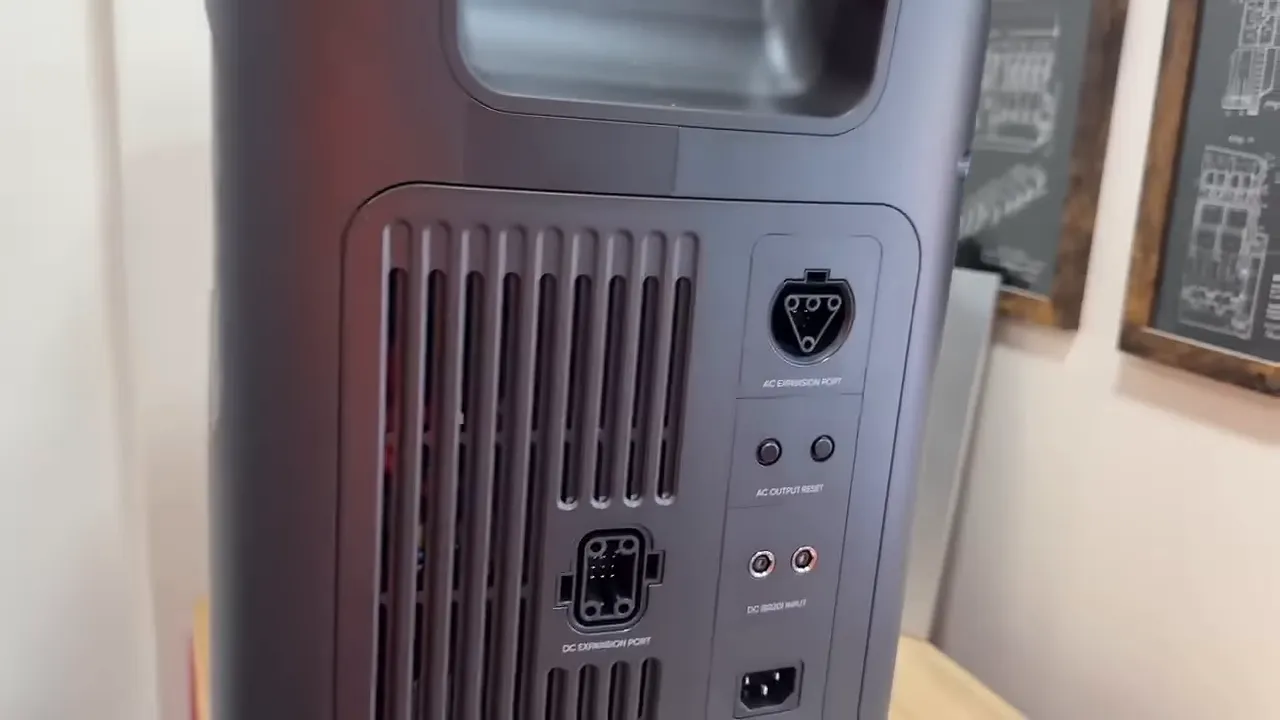
Here’s what you have for connections and controls:
- A dedicated 30-amp RV outlet on the front.
- Four standard household AC outlets, sharing the station’s overall 3,600-watt output capacity.
- Two USB-C ports and two USB-A ports for smaller devices.
- A front display showing battery charge, input power, output power, and estimated runtime.
- Wi-Fi and Bluetooth app connectivity for monitoring and additional settings.
- AC charging up to 1,800 watts from a suitable household outlet.
- Solar input up to 1,000 watts, plus expansion connections.
That 3,600-watt rating describes the power it can supply, not how long every appliance will run. Runtime depends on the connected load, remaining battery charge, and how those appliances cycle.
Supplying Essential Home Circuits Through a Power Inlet
My first test used an existing generator power inlet and a breaker-panel interlock. This lets a compatible backup source supply selected circuits through the home’s wiring instead of running extension cords to individual appliances.
Connecting through a home panel does not mean this is an unlimited whole-home power source. You still have to stay within the power station’s output rating and the electrical limitations of the connection.
What the inlet and interlock do
The power inlet is the connection point for the backup source. Properly sized wiring connects it to a dedicated breaker in the panel. I prefer the covered inlet enclosure on my installation because it provides better protection around the cord connection than a more exposed arrangement.
The interlock is the critical safety component. It mechanically prevents the utility main breaker and the backup-source breaker from being on at the same time.
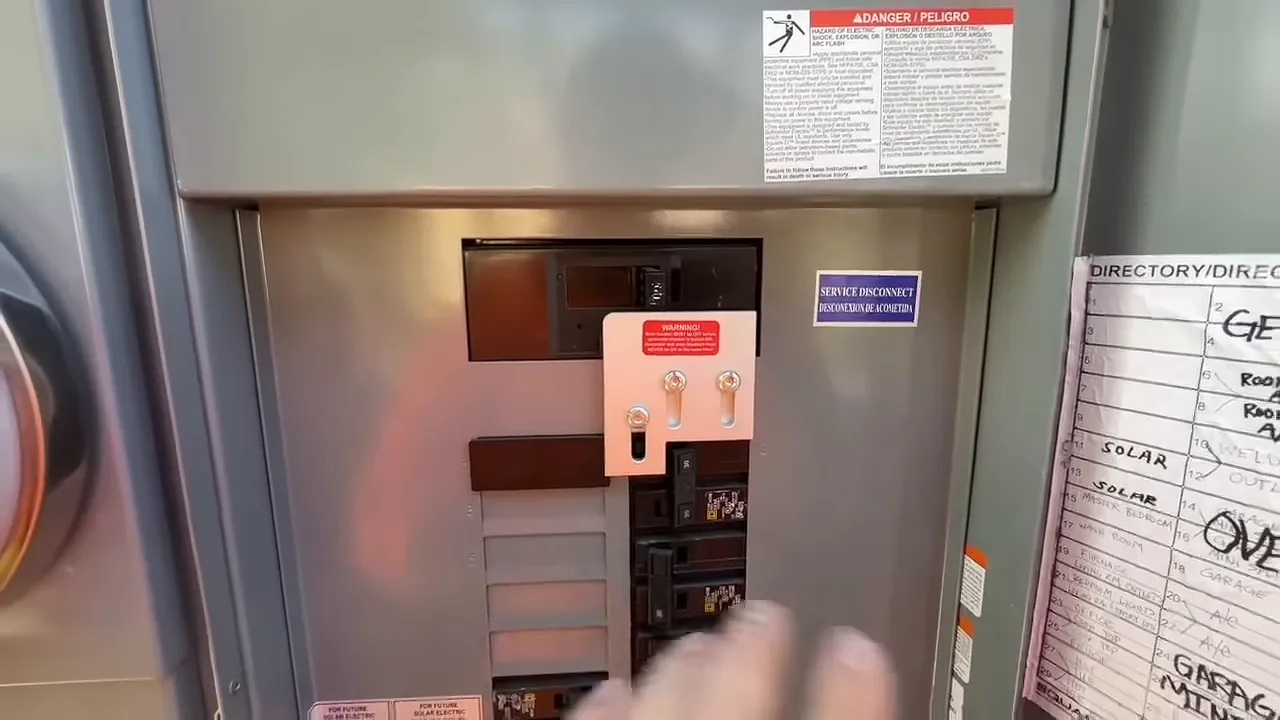
On my installation, switching to backup power requires turning the main breaker off before the interlock can move and allow the generator breaker to turn on. Returning to utility power requires the reverse isolation: the backup breaker has to be off before the main can turn on.
That separation prevents backfeeding utility lines, which can seriously injure someone working to restore service. A correctly installed inlet must also be isolated from utility power. Never assume exposed inlet prongs are safe simply because the enclosure is labeled as an inlet.
Have a qualified electrician verify the inlet, panel-specific interlock, grounding and neutral requirements, and power-station compatibility. A 120-volt RV outlet is not the same thing as a 120/240-volt split-phase generator output. A plug adapter does not create 240 volts or establish that a home-panel connection is safe, particularly where shared-neutral circuits are present. Never feed a home through a wall receptacle or use a male-to-male cord.
For broader outage preparation, Ready.gov’s power outage guidance is a useful reference.
Choose the loads before turning the power on
For this test, I turned off the hot tub circuit and isolated my separate solar system. I also left large loads such as the dryer and oven out of the plan.
The goal during an outage is pretty simple: keep the food cold, keep the house warm when needed, and power essential lights and devices. It is not to keep every appliance running as though nothing happened.
My inlet uses a four-prong, 30-amp connection, while the Jackery has a three-prong RV outlet. The demonstration used adapters because that was what I had available. For a permanent backup plan, have the correct listed cord arrangement and electrical compatibility verified rather than copying an adapter combination.
Home Backup Test: Turning Off Extra Loads Made a Huge Difference
With the backup connection established and the Jackery’s AC output enabled, the household load settled at roughly 1,400 watts. The display estimated about 2.5 hours of runtime.
That number initially looked pretty high for the essentials. Then I went inside and found out what was actually running.
- The kitchen refrigerator was powered.
- Another portable power station was charging at about 500 watts.
- The pool pump was running.
- A garage refrigerator and a separate freezer were also connected.
- Lights and other normal household loads were on.
Funny enough, I was using one battery to charge another battery without even thinking about it. That’s exactly the kind of unnecessary load you want to catch during an outage.
After turning off the pool pump and stopping the other power station from charging, the estimated runtime increased to 7.7 hours. At that point, we still had the kitchen refrigerator, garage refrigerator, separate freezer, and some normal household loads powered.
Then I turned off the garage lights and garage refrigerator. With the remaining refrigerator and freezer connected, the display showed approximately 214 watts and 13.3 hours remaining.
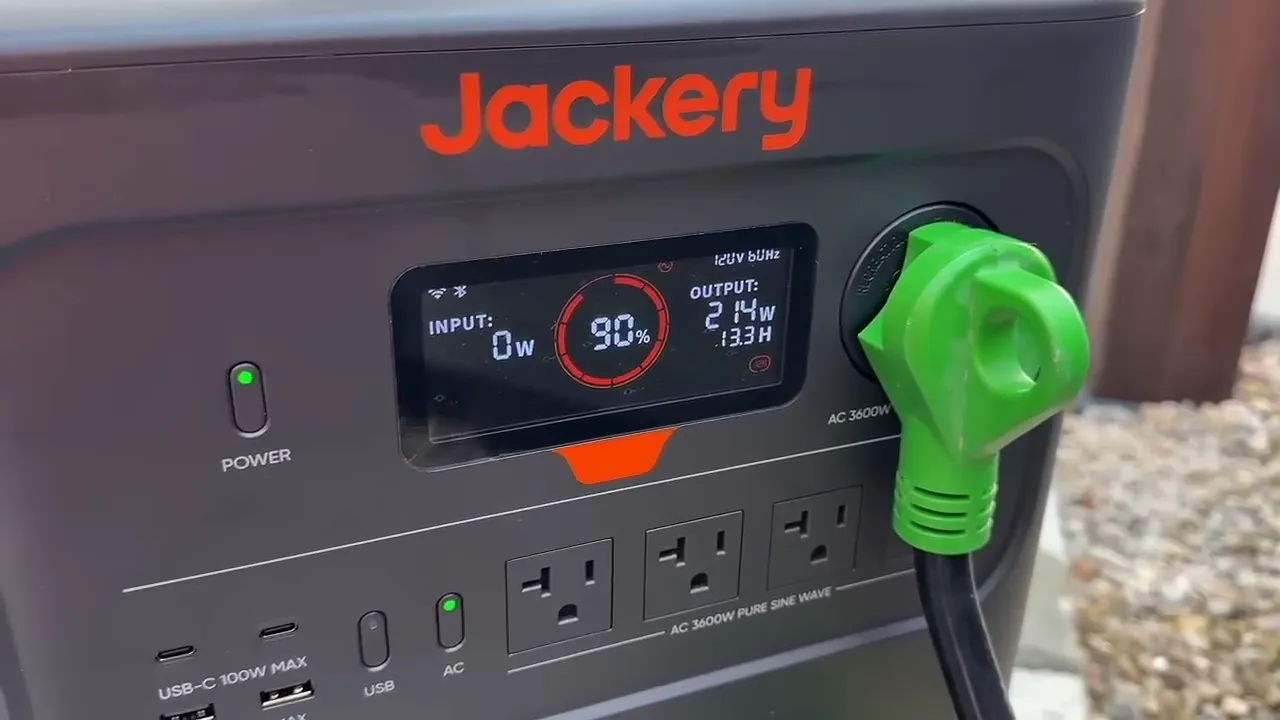
Those are live display estimates, not completed battery rundown tests. Refrigerators and freezers cycle on and off, so their draw and the remaining-time estimate will change.
Still, the practical takeaway is clear. Before deciding you need a bigger battery, check what you’re powering. In this test, cutting unnecessary loads moved the estimate from about 2.5 hours to more than 13 hours.
Running a Gas Furnace Without a Whole-Home Inlet
What if you don’t have a generator inlet or don’t want to connect a power station to the main panel? You can also set up backup power for the gas furnace by itself.
A gas furnace still needs electricity for its control board, inducer, ignition system, and blower. The gas supplies the heat, but without electrical power, the furnace cannot complete its normal operating sequence.
Many furnaces are hardwired through a service switch that looks like an ordinary light switch. There isn’t a cord you can simply unplug and move over to a battery.
The EZ Generator Switch setup
My furnace has an EZ Generator Switch installed beside it. This provides a dedicated inlet and a selector for normal power, off, and generator power, allowing the furnace to run independently from the rest of the house.
The unit demonstrated has a 15-amp protective device and is identified as UL listed. Listing is useful, but the installation still needs to follow the manufacturer’s instructions and applicable local requirements.
My installation took about 30 minutes, and the switch cost around $88 at the time. That’s a relatively inexpensive way to prepare a compatible furnace for backup power, although installation time and cost will vary.
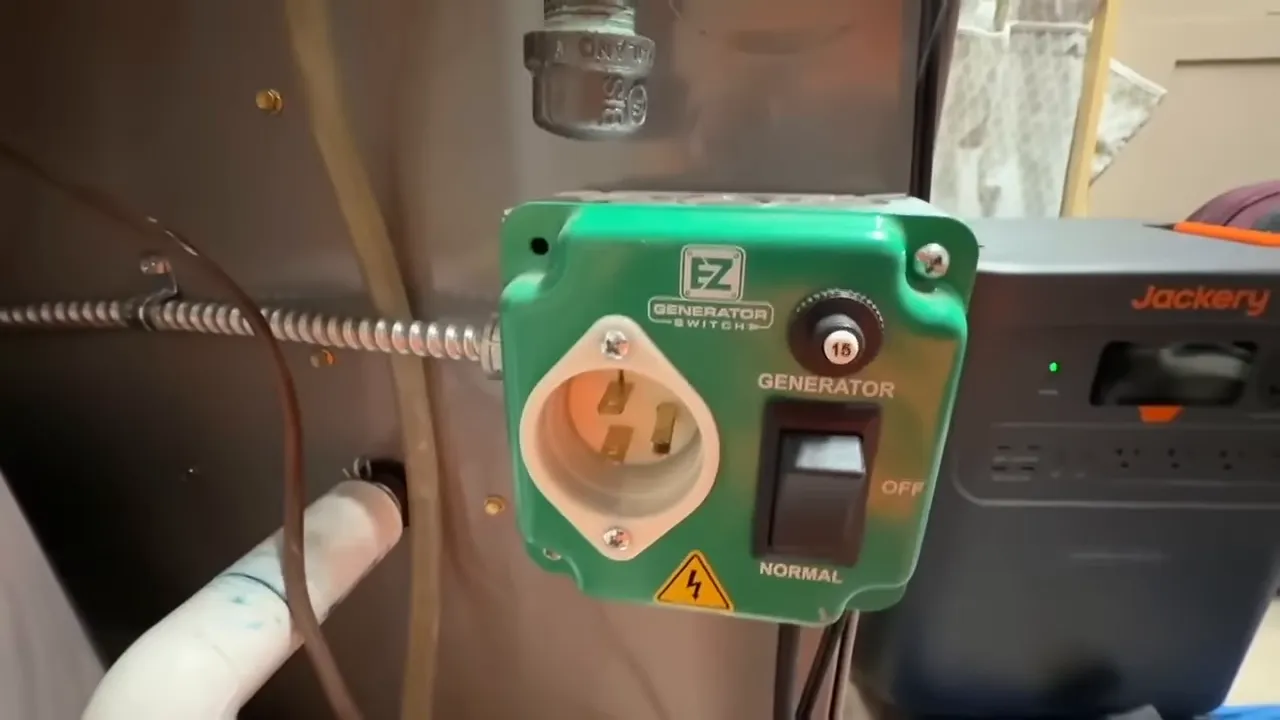
With that switch already properly installed, my operating sequence was:
- Move the furnace transfer selector to the off position.
- Connect a suitably rated extension cord from a standard AC outlet on the Jackery to the switch inlet.
- Select generator power on the furnace switch.
- Enable the Jackery’s AC output.
- Call for heat at the thermostat.
This is a transfer arrangement, not a way to bypass the furnace’s electrical or safety controls. Have a qualified professional confirm the setup is suitable for your furnace and backup source.
How much power did my furnace use?
I called for heat through the ecobee thermostat and checked the Jackery’s output as the furnace went through startup. Because power had been interrupted, the thermostat first needed roughly 30 seconds to reboot.
Here’s what I observed:
- Inducer running: approximately 79 watts.
- Hot surface igniter and inducer operating: a brief reading around 170 watts, then declining.
- After the blower came on and operation settled: approximately 135 watts total.
At that settled reading, the Jackery displayed an estimated 19.2 hours of runtime.
That’s pretty impressive for keeping heat available. But it is a result from this particular furnace, not a universal gas-furnace power requirement. Your blower and other components may draw considerably more.
The furnace also cycles off when the home reaches its setpoint. That can extend the elapsed time the battery supports heating compared with continuous operation, but outdoor temperature, thermostat settings, and actual furnace runtime all matter.
Does the smart thermostat still get power?
On this system, yes. The thermostat receives its operating power from the furnace’s low-voltage electrical system. As long as the furnace control system is powered, the thermostat can come back online and control heating normally.
It doesn’t care whether the furnace’s electricity originated at the utility or the backup battery. Remote app control is a separate matter and still depends on the necessary network connection being available.
Powering the RV While Boondocking
The dedicated RV outlet makes the Jackery convenient for camping. I plugged our camper’s shore-power cord into the front outlet with the AC output enabled, then tried several appliances.
With what I believed was primarily the RV refrigerator operating, the load was around 70 to 80 watts. The display estimated approximately 30 hours at that moment.
That makes it a useful option to keep charged and ready in the camper. As with the home refrigerator test, the estimate changes as appliances cycle and other devices turn on.
Microwave test
Running the microwave brought the displayed load to about 1,500 watts. That sucker pulls quite a bit of power.
But there’s a difference between a large load running for a couple of minutes and a large load running all afternoon. Being able to warm up food briefly is a practical use for the station, even though you wouldn’t want to leave a load like that running unnecessarily.
RV air conditioner test
Our camper has a TURBRO Greenland inverter air conditioner and heat pump. This is important because it is not a conventional fixed-speed RV air conditioner. Its inverter compressor ramps up gradually rather than starting abruptly.
I set it to cooling and lowered the setpoint to 64 degrees so it would run. Once the compressor came on, the Jackery showed about 613 watts, with readings fluctuating up to roughly 630 watts.
The displayed runtime estimate was approximately 4.9 hours. We had nice cold air coming out, and the compressor was quiet, with only a light buzz noticeable outside.
This demonstrates compatibility with my inverter RV air conditioner, not every air conditioner. A traditional RV compressor can have different startup requirements. This also was not a test of a home’s central air conditioner.
Electric water heater test
I also switched the RV water heater from gas operation to electric. The Jackery supplied it, but the electrical load increased substantially.
If gas is available, that’s how I recommend heating the water when you’re trying to conserve battery power. The battery can supply the electric water heater if needed, but electric resistance heating takes a big bite out of the energy you could otherwise use for refrigeration, lights, or cooling.
I did not complete a full water-heating cycle or measure how many showers the battery would support, so I wouldn’t use this test to promise a particular hot-water runtime.
Adding Solar Charging During an Outage or Camping Trip
The Jackery accepts up to 1,000 watts of solar input. I also showed the SolarSaga 500 panel arrangement, which uses connected sections that fold into an accordion-style shape.
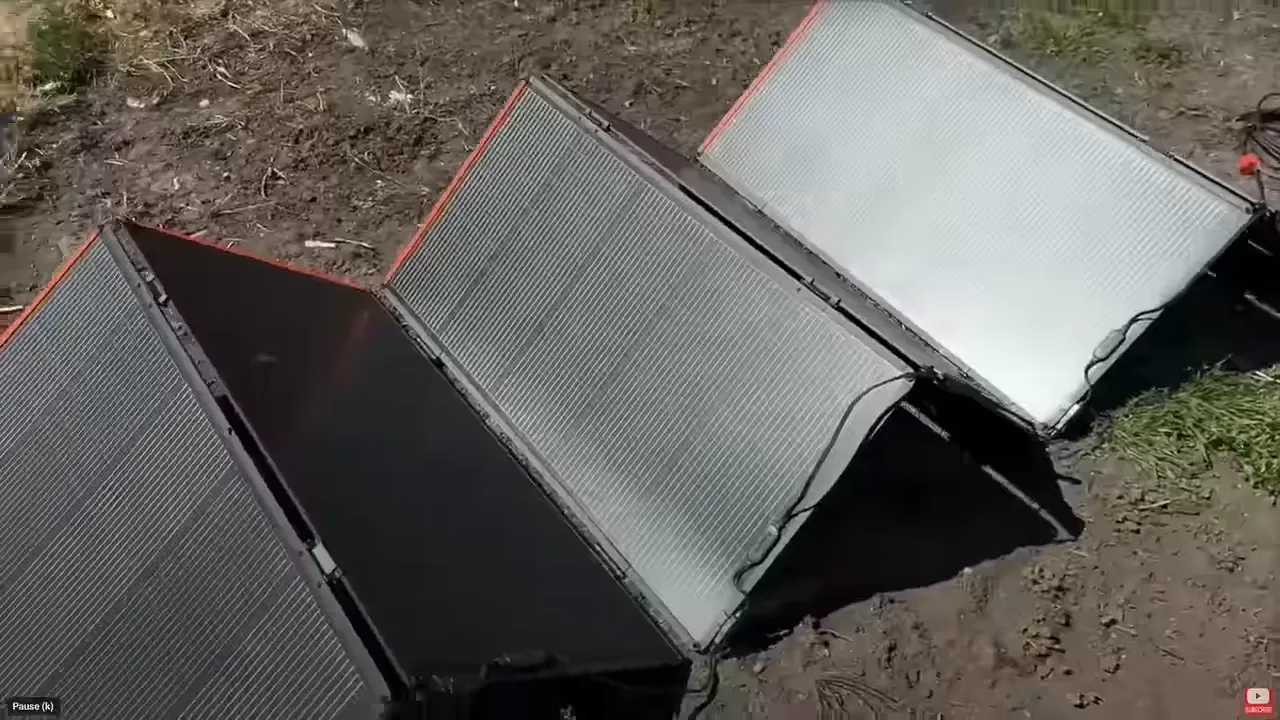
For boondocking or a longer outage, solar gives you a way to put energy back into the station while using it. That can help stretch the available battery energy instead of treating every charge as a one-time supply.
Just keep the limits in perspective. The maximum solar input rating is not a guarantee of actual charging power, and I did not measure a complete solar recharge in these tests. Whether solar keeps up depends on the available input and how much power your connected equipment is using.
My Take on the Jackery 3600 Plus
The Jackery 3600 Plus proved useful across several very different jobs. It supplied essential household loads through my existing backup connection, ran my gas furnace through a dedicated transfer switch, and powered the RV refrigerator, microwave, inverter air conditioner, and electric water heater.
The wheels and suitcase handle make its 77-pound weight easier to deal with, and the dedicated RV outlet is a genuinely handy feature. The biggest limitation is the same one every battery backup has: what you choose to run determines how long it stays useful.
My approach would be to prioritize refrigeration and furnace operation during a home outage, use short-duration appliances when needed, and avoid spending battery energy on unnecessary pumps, charging loads, or electric water heating when another option is available.
At the time of this test, the price was about $1,700, with the listed offer at $1,709. Prices and sales change, so check the current listing if this fits your backup-power plans. The shopping link below is an affiliate link.


