If you have a natural gas or propane furnace, a winter power outage can leave you without heat even when the fuel supply is still available. The furnace still needs electricity to run its controls, ignition system, inducer, and blower.
The challenge is getting backup electricity to it. Most furnaces are hardwired through a service switch, so there is no plug you can simply move over to a portable power station or generator.
A cord-and-plug connection can make that changeover much simpler where the furnace manufacturer and local electrical requirements permit it. The basic idea uses a receptacle, a grounded appliance cord, and a suitable strain-relief connector. During normal operation, the furnace plugs into utility power. During an outage, you unplug it and connect the furnace itself to an appropriate backup source.
The parts are simple. The electrical work still needs to be done correctly. Before modifying a furnace, have a qualified electrician or HVAC professional confirm that this arrangement is allowed for your equipment and location.
Key Takeaways
- Gas and propane furnaces still need electricity, even when their fuel supply remains available.
- An approved cord-and-plug arrangement allows the furnace to be disconnected from utility power before backup operation.
- Manufacturer instructions, local requirements, proper grounding, and cord protection determine whether the conversion is acceptable.
- The demonstration confirmed electrical startup, not a complete heating cycle or battery runtime.
Table of Contents
- How the Backup Power Connection Works
- Check Compatibility Before Buying Parts
- 1. Shut Off Power and Identify the Existing Wiring
- 2. Install a Proper Cord Entry and Strain Relief
- 3. Connect the Appliance Cord to the Furnace Supply
- 4. Wire the Utility Receptacle and Verify Grounding
- 5. Keep the Cord Accessible Without Blocking Maintenance
- 6. Switch the Furnace to Backup Power During an Outage
- Prepare the Connection Before You Need It
How the Backup Power Connection Works
Think of this as separating the installation into two sides:
- Utility side: The existing furnace branch circuit supplies a receptacle.
- Furnace side: A grounded appliance cord supplies the furnace through connections inside its approved electrical enclosure.
The furnace normally gets electricity by plugging that cord into the receptacle. If utility power fails, the cord is physically unplugged from the receptacle and connected to a suitable power station or an extension cord leading to an outdoor generator.
That physical separation is the important part. With the furnace plug removed from the utility receptacle, the backup source supplies the furnace rather than the house wiring.
This is not a method for feeding generator power into a wall outlet. Never use a male-to-male cord or attempt to energize household wiring through a receptacle.
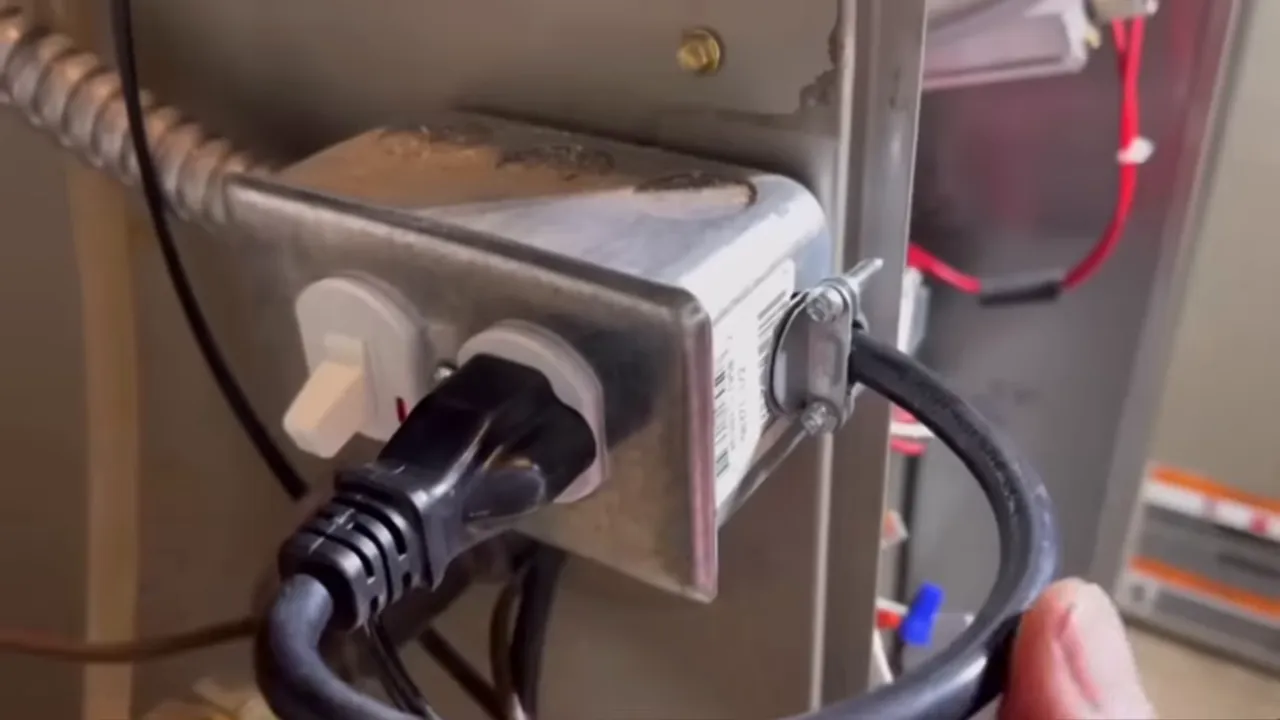
Check Compatibility Before Buying Parts
I like how straightforward this arrangement is, but a simple connection does not automatically make it acceptable on every furnace. Local requirements and the equipment installation instructions come first.
A plug may serve as a disconnect in an approved installation, but do not assume that removing the original service switch is permitted. Have the disconnect arrangement, receptacle location, grounding, and cord use checked before making changes. If cord-and-plug conversion is not permitted, ask about a listed furnace transfer device instead.
The demonstration furnace was a training setup, not a complete operating home installation. It also did not have gas connected during the backup power test. That matters when interpreting the results: the test showed electrical startup, not a complete heating cycle.
Parts used in this approach
- A grounded receptacle and matching cover: Selected for the branch circuit and approved installation.
- A three-conductor appliance pigtail: A cord with a factory-installed grounded plug and leads for the furnace connection.
- A listed cord connector or strain relief: Sized for the cord jacket and enclosure opening.
- Listed splice connectors: Compatible with the conductor sizes and with solid or stranded wire as applicable.
- Basic electrical tools: Suitable voltage-testing equipment, screwdrivers, and wire strippers.
For reference, the parts list includes an outlet, a 6-foot appliance pigtail, lever connectors, and a cord connector. These are component references, not a universal approved kit for every furnace.
The demonstration used a cord marked for 15 amps on a 15-amp circuit. Your installer needs to verify the complete combination of furnace load, circuit protection, cord type, conductor size, plug, and receptacle. Do not select a cord based on breaker amperage alone.
1. Shut Off Power and Identify the Existing Wiring
The first step is at the breaker panel, not at the furnace switch. Turn off the furnace branch circuit and verify that the conductors are de-energized before handling them. Do not rely only on a switch position or a panel label.
Once the cover is removed and the switch is carefully pulled forward, a typical arrangement may include:
- An incoming utility hot conductor connected to one switch terminal.
- A furnace hot conductor connected to the other switch terminal.
- Utility and furnace neutral conductors spliced together inside the box.
- Equipment grounding conductors connected to the switch, metal box, and furnace as applicable.
The key is positively identifying which conductors come from the branch circuit and which supply the furnace. Wire colors help, but they are not a substitute for identification and testing.
In the demonstrated conversion, the switch connections and neutral splice were separated so the furnace supply could be connected to its new cord. The utility hot and neutral would then supply only the receptacle. Protective grounding and bonding must remain correct throughout the finished installation.
2. Install a Proper Cord Entry and Strain Relief
A cord cannot simply pass through a bare hole in sheet metal. The jacket needs protection from sharp edges, and a pull on the cord must not transfer directly to the electrical splices.
The demonstration used an existing knockout near the furnace electrical box. A cord connector was secured in that opening with its locknut, and the appliance cord was routed through it with enough slack to reach the junction box.
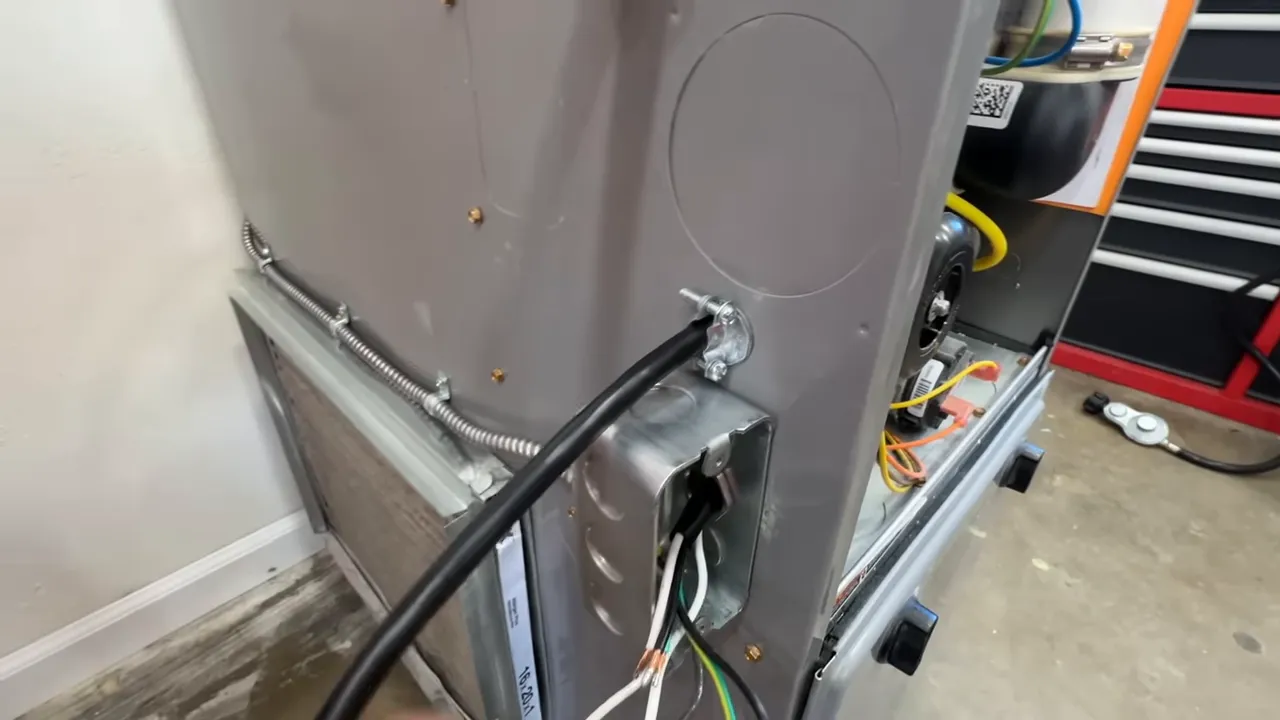
Use a connector specifically listed for the flexible cord being installed. A fitting that happens to fit the hole is not necessarily suitable for that cord.
The clamp should grip the outer jacket without crushing it. Inside the furnace, the cord must stay clear of hot surfaces, moving components, sharp edges, and service access areas. Any new opening must be permitted by the manufacturer and sized for the selected fitting.
3. Connect the Appliance Cord to the Furnace Supply
The furnace-side connections in the demonstration were straightforward:
- Black to black: Cord hot to furnace hot.
- White to white: Cord neutral to furnace neutral.
- Green to green: Cord equipment ground to the furnace grounding conductor, with required enclosure bonding maintained.
All splices belong inside an approved enclosure with adequate space. The furnace must not retain another hot or neutral connection to the utility supply that bypasses the plug.
Lever connectors or wire nuts?
I used Wago-style lever connectors because they are convenient when working with short leads and mixed solid and stranded conductors. A properly selected wire nut can also work.
With a lever connector, follow its specified strip length, insert the conductor fully, close the lever, and gently tug-check the connection. Inspect for exposed copper outside the connector and make sure no insulation is caught where the conductor should be clamped.
Electrical tape is not a substitute for a correctly installed connector. Use the connector according to its listing and instructions rather than relying on tape to hold a questionable connection together.
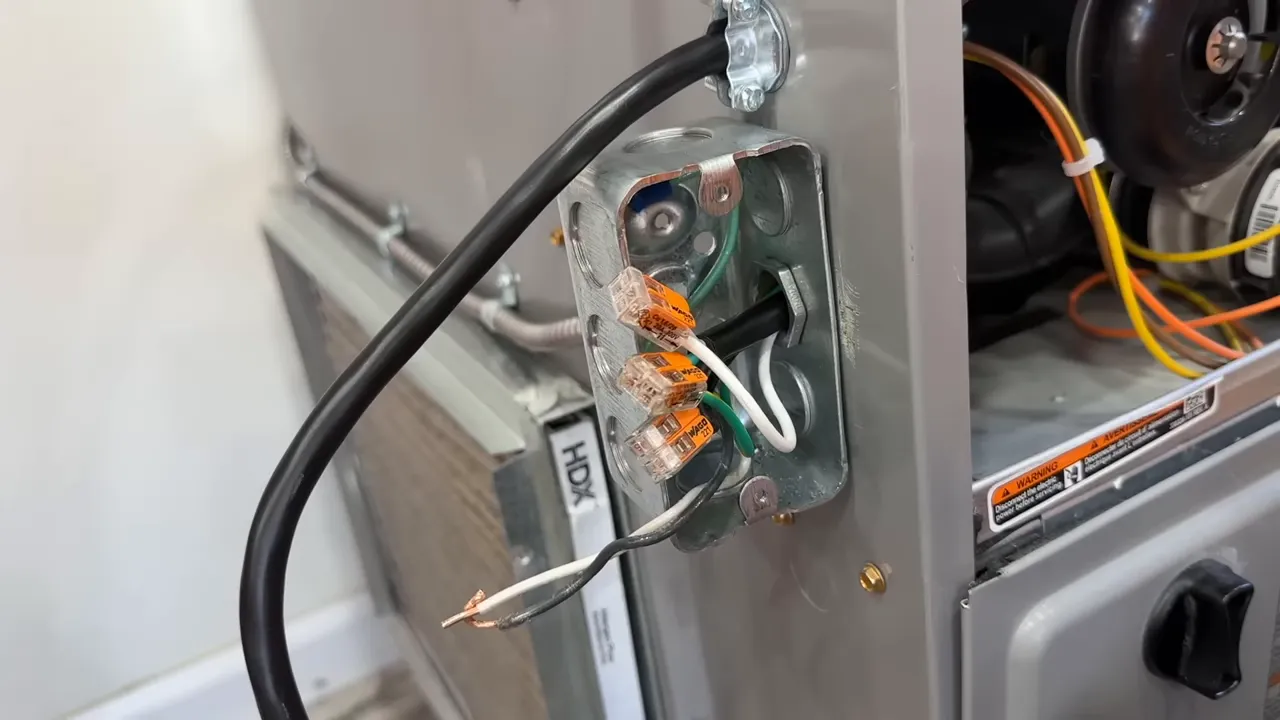
Match the terminal to the conductor
The existing furnace wiring used stranded conductors with crimped terminals, while the branch-circuit conductors were solid. Those connection methods are not interchangeable without checking the device instructions.
For a screw terminal designed for a hooked solid conductor, form the hook clockwise so tightening the screw draws the wire inward. The small looping holes on some wire strippers make that bend easy to form. Stranded wire, crimp terminals, and pressure-clamp terminals must each be used only in combinations the manufacturer permits.
4. Wire the Utility Receptacle and Verify Grounding
The utility conductors supply the new receptacle. On a standard receptacle, the terminal identification is:
- Hot: Brass-colored terminal.
- Neutral: Silver-colored terminal.
- Equipment ground: Green grounding terminal.
Use terminal markings and screw colors rather than “right side” or “left side,” because the receptacle can be mounted in different orientations. Tighten connections to the device manufacturer's specified torque.
Grounding deserves special attention. A bonded metal box does not automatically mean every receptacle is properly grounded through its mounting screws. Whether that connection is acceptable depends on the device, box, and approved mounting arrangement.
Have the receptacle grounding path, metal-box bond, and furnace grounding path verified. Where required, use an equipment-grounding pigtail to the receptacle rather than assuming metal-to-metal contact is sufficient.
After inspecting the wiring, carefully position the splices and receptacle without pinching conductors. Install the cover and replace furnace panels before restoring power and testing normal operation. Do not bypass a furnace door safety switch.
5. Keep the Cord Accessible Without Blocking Maintenance
The finished connection should be easy to reach, but it should not interfere with changing the filter or removing service panels.
In the demonstration, the excess cord was gathered beside the furnace to keep it out of the filter path. For a permanent installation, use an approved routing and support method that protects the cord without putting stress on the plug or strain relief.
A longer cord may make it easier to reach a nearby power station, but extra length is not automatically better. Choose the cord length and routing as part of the approved installation, and keep it away from heat and physical damage.
6. Switch the Furnace to Backup Power During an Outage
Once the installation has been approved and tested, the changeover is the easy part:
- Unplug the furnace cord from its utility-powered receptacle.
- Connect it to a compatible portable power station, or to a properly rated extension cord supplied by an outdoor generator.
- Enable the backup source's AC output.
- Allow the furnace to go through its normal startup sequence and confirm proper operation.
A fuel-burning generator must remain outdoors, at least 20 feet from the home, with its exhaust directed away from the building. Never run one in a garage or basement. The Consumer Product Safety Commission's generator safety guidance explains the carbon monoxide precautions.
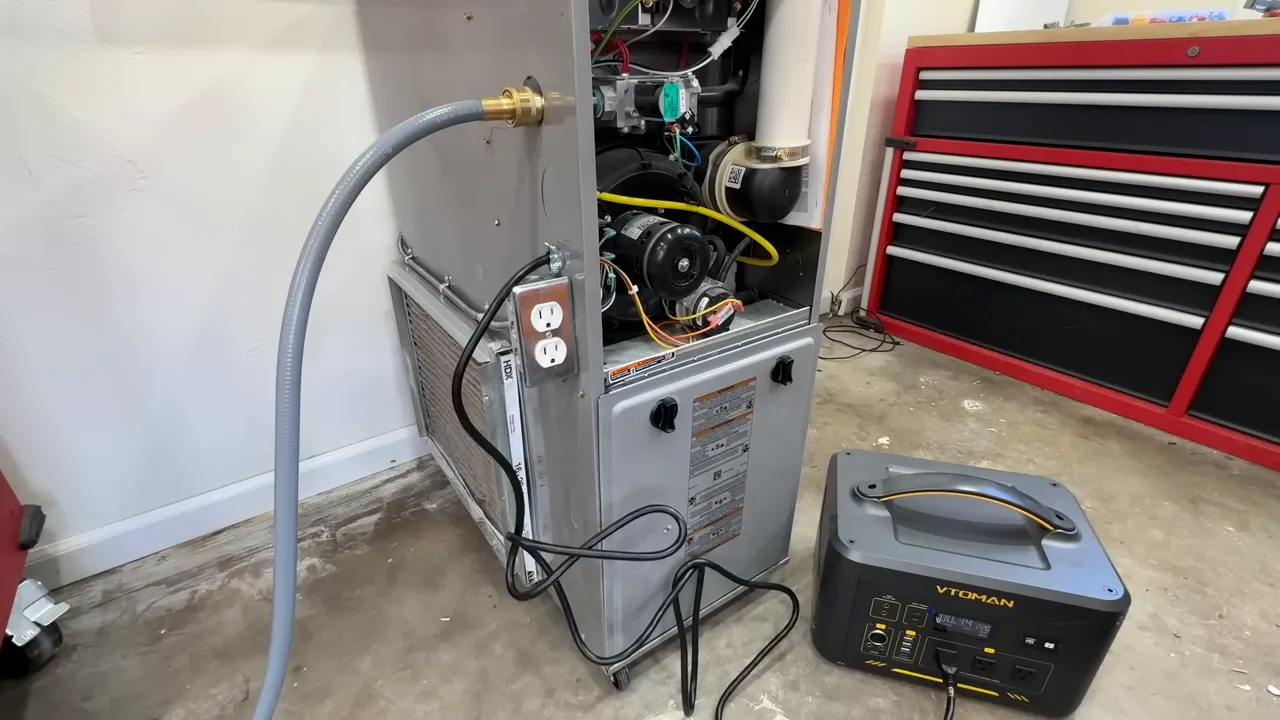
What the startup test actually demonstrated
I used a Vtoman power station described as a 1,000-watt unit for the demonstration. After AC output was enabled, the blower started. Following roughly a minute, the inducer came on, and the hot-surface igniter energized.
There was no gas connected to the demonstration furnace, so the burners did not light. The test confirmed that the backup source could power those startup components on that furnace. It did not establish full heating performance or battery runtime.
Do not assume that any 1,000-watt power station will operate any furnace. Verify the furnace's running load, startup requirements, and compatibility with the backup source, including its grounding and neutral arrangement. Have any ignition or flame-sensing compatibility issues evaluated professionally rather than improvising wiring changes.
When utility power returns, disconnect the furnace from the backup source and reconnect it to its normal receptacle.
Prepare the Connection Before You Need It
The real benefit here is not a particular outlet or connector. It is having an approved way to supply the furnace directly without feeding backup power into the house wiring.
If you do not own a generator or portable power station, a vehicle paired with an appropriately sized inverter is another approach to investigate. I cover that separately in my vehicle-powered furnace guide. It is not as simple as assuming a vehicle accessory outlet can handle the furnace load.
Get the installation checked, confirm that your backup source works with your actual furnace, and test the setup before winter weather arrives. Simple operation during an outage starts with careful preparation while the lights are still on.


